Friday, 5 April 2013

Photography


Changed peoples lives in the 19th century
The camera obscura and other drawings had existed for several years but the photograph seems to only have taken some 50 years to develop from concept to presentation in 1839

Camera Obscura : People knew the principles of how photography got to work before it was created.The image could be processed on the wall or piece of paper. The camera obcura[ latin for dark room] was used to process pictures.
It was possibly invented around the 13th-14th century.
Camera obscurais essentially a dark closed space in the shape of a box with a hole on the side. The light coming through the hole transforms and creates an image on the surface that it meets like the wall of the box but upside down.


Photography wa only for profesionals or the rich till George Eastman started a company called Kodak in the1880s. He created a flexible roll film that did not require constand changing of solid plate.
He then developed a self contained box camera that held 100 exposures of film.
The customer would use this to take pictures, then send it back to the factory for the film to be developed. This was the first cheap camera the average person could afford, kind of like todays disposable camera.
According to a survey made by Kodak in 2007 when the majority of photography was already digital, 75 percent of professional photographers say they will continue to use film, even though some embrace digital.
The Photo marketing Association say that in the year 2000 nearly a billion rolls of film were sold each year and by 2011 a mere 20 million rolls, plus 31 million single-use cameras.


The History of the Kodak Company . 2013. The History of the Kodak Company . [ONLINE] Available at: http://otal.umd.edu/~vg/amst205.S97/vj19/Project5-2.html. [Accessed 05 April 2013].

D.Collins, The story of kodak
Harry N. Abrams , Incorporated, 1990

Impressionism

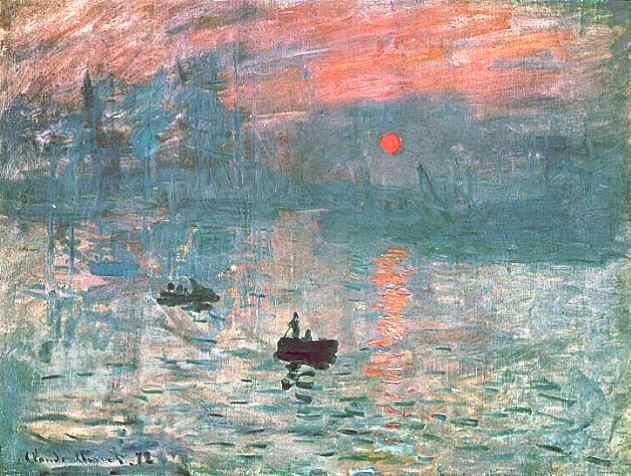
Impression: soleil levant
Claude Monet

Impressionism is a nineteenth century art movement.
Impressionist art is a style were the artist paints the image of anobject as he sees it, even if it's just a glimpse. They paint using alot of colour, to make it very bright and vibrant, being as they are usually outdoor  scenes.
  Some of the greatest impressionist artists were Edouard Manet, Camille Pissaro, Edgar Degas, Alfred Sisley and Claude Monet

"Manet influenced the development of impressionism. He painted everyday objects. Pissaro and Sisley painted the French countryside and river scenes. Degas enjoyed painting ballet dancers and horse races. Morisot painted women doing everyday things. Renoir loved to show the effect of sunlight on flowers and figures. Monet was interested in subtle changes in the atmosphere." from http://www.cs.ucf.edu/~MidLink/Impress.html

 Characteristics include: small,thin yetviible brush strokes, open composition, emphai on accurate depiction of light.

Some information on some of the artists:


Edouard manet: He took up painting after constantly failing trying to get into the navy. He tudied under Thomas couture, a famou academic painter during that time. He visited many different places like brazil, Holland, Italy and Germany and was influenced by the old masters, especially those of the golden ages of spanish and venetian painting. His work began to cause a stir in 1863 but he became the most recognized figure in the Impressionist group. Bringing to them his idea of "pure painting".
 Camille Pissaro:  Rejecting to work in the family business, pissaro pursued the study of art as a child.
Pissarro settled in paris in october 1855 and met many artists of the day like Camille Corot who encouraged him to paint the landscape but to focus on village imagery of river and towns. Pissarro studied art at the Atelier suisse in Paris with his fellow artist, claude monet, paul cezanne and armand guillaumin. By late 1860s his landscapes were praised by critics like EmileZola and becameoneof the most influential members of the impressionist movement.


Edgar Degas : Moving on from studying law, degas entered the Ecole des Beaux- arts in 1855. Travelling to italy he found himself fastinated by the early renaissance painters. He later joined the impressionists yet remained an artist who prefered  painting indoors in order and neat surroundings.
Degas's famous bronze figures were cast after his death using the wax models he left in his studio.


A List of Impressionist Artists – Artists in the French Impressionism Movement and its Circle. 2013. A List of Impressionist Artists – Artists in the French Impressionism Movement and its Circle. [ONLINE] Available at: http://arthistory.about.com/od/impressionism/ig/impressionism/03_people.htm. [Accessed 05 April 2013].

Monday, 1 April 2013

Japonisme


Emerged in western Europe in the 1850s and 60s. Due to trade, many Japanese imports were sent to Europe and other parts of the world. From the 1860s, woodcut prints by masters of the Ukiyoe school meaning the floating world flooded  European shores
woodblock prints can date to the early 8th century in japan. [Purpose to distribute texts, especially Buddhist scriptures]

The woodblocks became a source of inspiration for many EU impressionist painters. Artists were effected by the lack of perspective and shadow, the flat areas of strong colour and the compositional freedom by not having the main image in the centre.
  The production of  Japanese woodblock prints is a complex process, involving a number of steps, each usually performed by a different person, one skilled in that particular step.
Block carving, printing, repeat printing and final touches.
View : mercury.lcs.mit.edu/~jnc/prints/process.html for detailed diagrams of process.

Suzuki Harunobu, Winter Scene of Black Crow and White Heron, Woodblock print 
 An example of a japanese woodblock print.
The outline would have been carved into the woodblock. Piece by piece, parts of the image would get "coloured in" using a type of stencil with flat colour.
Lack of shadows and overall flatness yet amazing carving work makes this type of art very interesting. Even though there isnt much detail in the colours, the general carved detail somewhat makes up for it.


Japonism - Wikipedia, the free encyclopedia. 2013. Japonism - Wikipedia, the free encyclopedia. [ONLINE] Available at: http://en.wikipedia.org/wiki/Japonism. [Accessed 01 April 2013].

Sunday, 31 March 2013

John Ruskin


John Ruskin was born in London, in 1819.
He is mainly known for his work in the field of art, literature and architecture. Also being an art critic, was remembered for his ideas of socialism and contribution towards promoting Gothic architecture.
Ruskin wanted to reunite the designer and the craftsman, spiritual and the everyday.
He believed that any building or object must be created with enjoyment to be valued.Ruskin believed that the architects and the designers of the Gothic period enjoyed complete freedom of expression in their work.

Ruskin's interest in particularly Gothic architecture led to first of his works to bear his name " the seven lamps of architecture" [1849] containing 14 plates etched by him. The title revers to seven moral categories that Ruskin considered vital to and inseparable from all architecture : sacrifice, truth, power, beauty, life, memory and obedience.


Condemned the machine oriented society of Victorian Britain as he thought machinery destroyed creativity.


Together with William Morris and Augustus Pugin, Ruskin founded the arts and crafts movement in the 1860s-1910
It developed first and most fully in the British isles but spread to Europe and north America.
Being a symbol for traditional craftsmanship by using simple forms and applied medieval styles of decor.
Has been said to be essentially anti-industrial.


John Ruskin — Biographical Materials. 2013. John Ruskin — Biographical Materials. [ONLINE] Available at: http://www.victorianweb.org/authors/ruskin/bioov.html. [Accessed 31 March 2013].

Tuesday, 5 March 2013

Vincent Van Gogh


Vincent van gogh - "the tortured artist"


Was a Dutch post-impressionist painter whose work influenced the 20th century. Vincent van gogh was born on march 30th 1853 in Groot Zundert, Netherlands. His artwork is still changing the way people view  beauty, persona, individuality, and style in art. His thousands of paintings and drawings have various characteristics that have been copied but duplicated by none.
He had an emotional life, filled with loneliness and despair. Struggled with poverty and mental illness.


Vincent is one of the most well-known artists in the world, but only after his death. During his life, his art wasn’t taken very seriously as not many understood him or his works so his paintings were hard to sell.


Today, his paintings have become easily recognizable.
As most families in the mid-1800's, van Gogh was raised in a religious family and his father was a minister. Van Gogh was intelligent and multi-lingual.
He began painting while living in Amsterdam after his heart got broken by a past love. Vincent devoted himself to paintings, studying colours and admiring works of artists like peter paul rubens.
After moving to Paris, Vincent began to develop the style that made him famous. His bold, dramatic brush strokes expressed emotion as well as added a feeling of movement to his artworks. Being mostly self taught, van Gogh started his career copying prints and reading 19th century drawing manuals and books, which was where his technique grew. He wanted to master black and white drawings before using colour, and focused on learning the most important things for figure drawings before depicting landscapes in the right perspective. After being satisfied with his technique, he began to add colour and his palette, which stood out quite a lot, became one of the most identifiable features of his later paintings


Vangogh produced 900 paintings in 10 years. Took his own life in 1890.


 Vincent still inspires people of the present. An example of this is the episode of Doctor who, a british series. An episode was done with an actor being Vincent van gogh.
 Trailer: https://www.youtube.com/watch?v=se_8Z3P7h3s
note: its an amazing episode. please watch it all <3  


Vincent van Gogh Biography - His Life and Times . 2013. Vincent van Gogh Biography - His Life and Times . [ONLINE] Available at: http://www.vangoghgallery.com/misc/bio.html. [Accessed 05 March 2013]. 
 Julius Meier-Graefe

J.M.Graefe, Vincent Van Gogh - a Biography 
Dover 1987 

William Harvey (artist)

William Harvey (artist)


Was an english engraver and designer.

In london in 1817 he studied drawing and anatomy. He switched to design after the death of John Thurston (an english engraver and illustrator and was lead wood designer in london)

In seceral of his wood engravings, harvey mimiced copper-plate engravings by crosshatching and the "Treatise on wood engraving" comments this talent of crosshatching on wood aswell as showing the beauty of simple designs.

After some time, harvey left wood engraving and became a book designer.


 William Harvey (artist) - Wikipedia, the free encyclopedia. 2013. William Harvey (artist) - Wikipedia, the free encyclopedia. [ONLINE] Available at: http://en.wikipedia.org/wiki/William_Harvey_%28artist%29. [Accessed 16 May 2013].

Mangaka

Mangaka

Being the japanese word for comic artist or cartoonist.


manga became popular in the 20th century and are a big part of japanese culture. Manga are japanese comic books, usually consisting of more pages and coming in a set.

Manga are often made into anime [japanese animations]. Manga is very popular with young people and even influenced the art styles of certain artists like Ed McGuinness, Brian wood and frank miller [comic artists]

Japanese manga is to be read from the right side to the left not only from pages but even panels.

Example of how a manga needs to be read:


There are many different characteristics that make manga distinctive. Manga characters almost always have large eyes, small mouths and usually un-natural hair colour. Character emotions are exaggerated. For example, when a character cries, it pours like a waterfall, Or when they laugh, their wide mouth takes half their face.


As an anime and manga fan i obviously love this style. Reading manga is quite an experience and to just stop and admire the art work. Loving it more when it turns into an animation[ anime]


Mangaka - Wikipedia, the free encyclopedia. 2013. Mangaka - Wikipedia, the free encyclopedia. [ONLINE] Available at: http://en.wikipedia.org/wiki/Mangaka. [Accessed 05 March 2013]. 

P.Gravett,  Manga:60 Years of Japanese Comics,
Laurence King Publishing, 03 Aug 2004